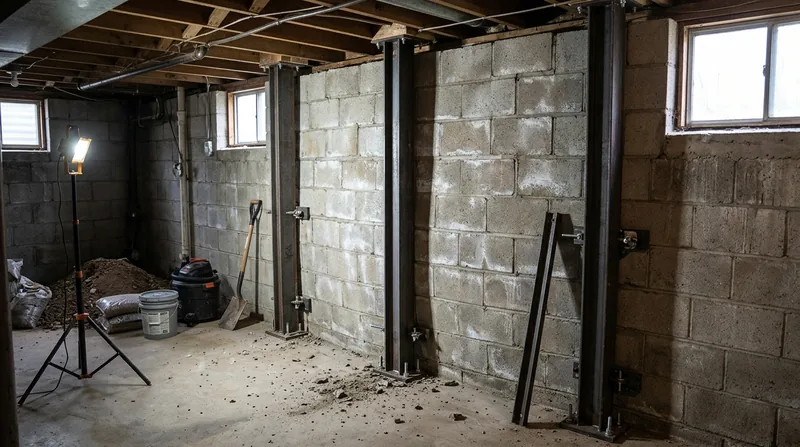




Sioux Falls sits on the open northern plains along the Big Sioux River, and the ground under most of the city is dense glacial till clay that drains slowly and holds water against your foundation. That clay expands when the spring water table rises with snowmelt, then the deep frost and hard freeze-thaw cycles work the wall from both sides. In older neighborhoods like Pettigrew Heights, Whittier, and around McKennan Park, that pressure lands on 1910s-1940s block and brick foundations that were never designed for it. Bowing Wall Repair in Sioux Falls is about stopping that inward movement before the wall loses the rest of its capacity. We match the method to how far the wall has moved and what your soil is doing, and we tell you honestly when a wall is stable enough that monitoring is the right call. If the wall is also wet, start with a basement waterproofing assessment so the water source gets addressed alongside the structure.
Why Bowing Walls Are Common in Sioux Falls Basements
Most of the bowing walls we see are in the older core of Sioux Falls, where block and brick basement walls sit on shallow footings in that heavy clay. When the water table climbs in March and April, saturated clay pushes inward with hydrostatic pressure while the frost line is still deep. The wall cracks horizontally at mid-height, pushes in at the middle, and the top and bottom stay put. Newer poured-concrete basements in southwest and southeast Sioux Falls can bow too, usually from poor grading or a failed footing drain that keeps the soil saturated year after year.
- Horizontal cracking near mid-wall is the classic sign that lateral soil pressure is pushing the wall inward.
- Doors and windows that suddenly stick, or a gap opening at the top of the wall, point to movement that is still active.
- Efflorescence and white staining on the block mean water is moving through the wall, not just against it.
- A visible curve you can see when you sight down the wall from one corner means the movement has gone past hairline.
- Diagonal stair-step cracking in the mortar joints often follows the same pressure that causes the bow.
Any one of these is worth a look, and two or more together mean you should get the wall assessed before the next spring melt.
Key info: A 1920s bungalow near McKennan Park with a block wall bowing about 1.5 inches at mid-height is a typical Sioux Falls call. Saturated clay and deep frost did the pushing, and the fix is usually carbon fiber straps on the interior face, not excavation.
For the structural side of the code, the City of Sioux Falls Building Services division handles foundation repair permits, and you can check current requirements at siouxfalls.gov before any work begins.
How We Repair a Bowing Wall in Sioux Falls
We start by measuring the wall, not guessing at it. A plumb line or laser tells us how far the wall has moved and where the pivot points are, and we check the footing drain and grading at the same time. That tells us whether the pressure is still active. From there we match the repair to the severity: straps for moderate movement, anchors or steel beams when the wall has moved further or the soil load is higher. We pull permits where the city requires them and we do not open the wall up unless the method calls for it.
- We inspect the full wall, the footing, and the exterior grade to find where the water and pressure are coming from.
- We measure the deflection and record crack widths so the repair can be compared against a baseline later.
- We recommend the method that fits the movement, from carbon fiber straps to wall anchors to steel I-beams.
- We install the system, tighten it to spec, and seal the cracks that are letting water through.
- We correct the grading and downspout extensions so the soil stops reloading the wall.
If the wall is wet as well as bowed, we coordinate the structural repair with an interior drain tile system so the water is managed at the footing instead of sitting against the wall.
Key info: In a 1950s ranch in central Sioux Falls, the block wall had bowed about an inch and the downspouts dumped right at the corner. We installed carbon fiber straps, sealed the horizontal crack, and extended the downspouts eight feet out. The wall has held stable through two spring melt cycles.
Repair Methods We Use and When Each One Fits
The method has to match the movement and the soil, and the wrong method wastes money without stopping the bow. Here is how we decide.
| Approach | Description | Best for |
|---|---|---|
| Carbon fiber straps | Straps bonded vertically to the interior wall face and anchored top and bottom. | Moderate bowing under about 2 inches with a stable footing. |
| Steel I-beams | Vertical steel beams set against the wall and tied into the floor and joists. | Heavier movement or walls where straps alone are not enough. |
| Wall anchors | Earth anchors outside tied through the wall to interior plates, with the wall pulled back toward plumb. | Walls that have moved further and can be straightened over time. |
| Crack injection and sealing | Epoxy or polyurethane injection into the crack, plus parging where needed. | Hairline and shrinkage cracks that are not yet a structural bow. |
| Drainage correction | Grading, downspout extensions, and footing drain repairs to cut the pressure source. | Every repair, because the soil load has to be reduced or the bow returns. |
We only recommend a structural method when the wall has actually moved. A crack that is not bowing gets sealed, not strapped.
Bowing Wall Repair Cost in Sioux Falls: What to Expect
Pricing starts at $600 for crack injection and minor sealing work where the wall is not structurally bowed. Once a wall needs carbon fiber straps, steel beams, or anchors, the number climbs with the length of wall involved, the number of straps or beams, and whether the footing drain or grading also needs correction. A single-wall strap job on a typical Sioux Falls bungalow sits well above that starting figure, and a full-wall anchor system on a longer block wall sits higher again. We give you the number after we measure the wall, not before.
Get two or three estimates and compare what is actually being installed, not just the total. A quote that does not include drainage correction is leaving the pressure source in place. You can see our full breakdown on the pricing page.
Choosing a Bowing Wall Repair Contractor Near Sioux Falls
Ask for the license and insurance certificate before anyone touches the wall, and confirm the company carries general liability and workers' compensation. Ask whether they pull the permit themselves or leave it to you, because structural foundation repair commonly requires one in Sioux Falls and the rules are set by the city building department. Ask for references from jobs like yours, on the same kind of block or poured wall, and call them. And get the scope in writing, including whether drainage correction is part of the job.
We are a Basement Health Association member and we work below grade only. If you want a straight read on your wall, contact us and we will measure it and tell you what it needs.
Bowing Wall Repair Near Me: What Sioux Falls Homeowners Should Know
If you are searching for bowing wall repair near me in Sioux Falls, the first thing to understand is that a bowing wall is a structural problem, not a waterproofing problem, even when water is what caused it. The water has to be managed, but the wall itself has to be stabilized or it keeps moving. We see this most in the older neighborhoods on the near-east and near-south sides, and in Brandon and Hartford where the same clay sits under newer homes with grading that sends water toward the foundation.
Do not wait for the wall to crack through. A wall that has moved an inch can often be strapped and held. A wall that has moved three inches may need anchors and a longer repair. Call (605) 937-6823 and we will tell you which one you are looking at.
Seasonal Timing for Bowing Wall Repair in Sioux Falls
The demand here follows the melt. Most bowing walls show their worst movement in March and April, when snowmelt hits ground that is still frozen below and the water table rises along the Big Sioux. That is when homeowners call. The best time to schedule the repair is late spring through fall, when the soil has drained and the wall is not actively being pushed. Winter work is possible on interior systems, but we plan around the frost.
Bowing Wall Repair in Sioux Falls: Pricing Guide
| Service | Price | Details |
|---|---|---|
| Crack injection and minor sealing | Starting at $600 | Injection of hairline or shrinkage cracks where the wall has not bowed, plus surface sealing. |
| Carbon fiber strap system | Starting at $1,800 | Interior straps bonded and anchored along the bowed section, priced by wall length and strap count. |
| Steel I-beam or wall anchor system | On estimate | Heavier movement needs an on-site measurement of deflection, wall length, and soil load before pricing. |
| Drainage correction add-on | On estimate | Grading, downspout extensions, and footing drain work priced with the structural repair after inspection. |
| Travel | Included | In Sioux Falls and surrounding areas, no separate call-out or mileage fee. |
| Estimate | Free | Response within 24h at (605) 937-6823, no obligation to book. |
Indicative pricing, the exact cost depends on square footage, finish, and site access. Free personalized estimate within 24h at (605) 937-6823.


