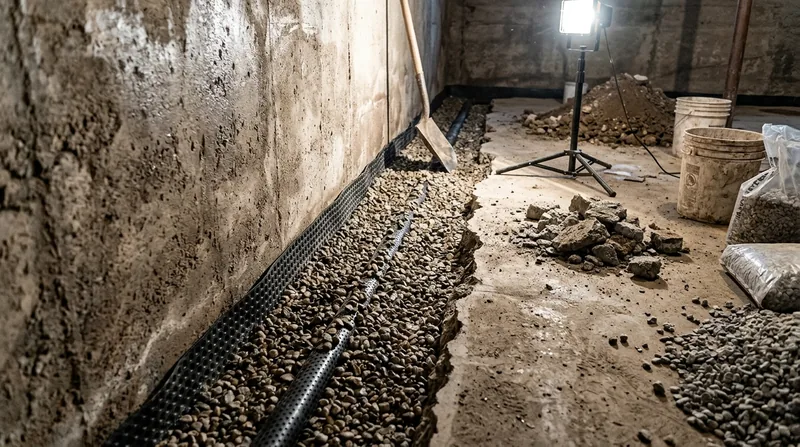




Interior Drain Tile System in Sioux Falls
Sioux Falls sits on the open northern plains along the Big Sioux River, and the ground beneath most of the metro is dense glacial till clay that drains slowly and holds water against the foundation. When the spring water table climbs with snowmelt over still-frozen soil, or after a hard summer downpour, that water finds the footing and pushes upward and inward. An Interior Drain Tile System in Sioux Falls captures it at the base of the wall, channels it to a sump basin, and pumps it away before it reaches your floor. We install these systems in the 1910s bungalows around McKennan Park and the poured-concrete basements of southwest Sioux Falls alike. If you are dealing with a wet basement, start with our basement waterproofing overview, then we can size the drain tile to your foundation.
Why Interior Drain Tile Matters in Sioux Falls' Clay and River Ground
The failure mode that dominates here is hydrostatic pressure from saturated glacial clay. Water moves through that till slowly, so it stacks up against the footing drain and the basement wall instead of draining away. Deep frost, spring snowmelt over frozen ground, and the 2019 river flooding all push the water table higher than most homeowners expect.
- Clay soil around the footing cannot shed water fast enough, so it presses against the foundation.
- Frozen ground in March and April forces snowmelt sideways toward the basement wall instead of down.
- Older Victorian and Queen Anne homes on pink Sioux quartzite foundations in the Cathedral district often have no working footing drain at all.
- 1950s to 1970s ranches on block basements across central and east Sioux Falls show water at the cove joint after every heavy spring rain.
- Sump pump failure during a storm turns a managed system into a flooded floor within hours.
An interior perimeter drain intercepts that water at the footing before it reaches the slab, which is why it works year-round where the clay never fully dries out.
Key info: A homeowner in Pettigrew Heights had water crossing the floor every March for years. The footing drain was crushed under the original 1920s slab. We cut a new interior perimeter drain and tied it to a sump basin, and the spring melt now runs to the pit instead of the floor.
Permits for work that alters drainage or the sanitary connection of a sump discharge vary by jurisdiction, so confirm requirements with the City of Sioux Falls Building Services Division before work begins. You can check current permit guidance at siouxfalls.gov.
How We Install an Interior Drain Tile System in Sioux Falls
We do not guess at the water source. We walk the basement, read the walls for efflorescence and seepage lines, check the existing sump basin and discharge line, and look at grading and downspout extension outside. Then we lay out the drain path and the pit location before any concrete comes up.
- We break and remove a 12 to 16 inch strip of slab along the perimeter wall and haul the concrete out.
- We dig down to the footing and true up the trench so the pipe sits at a consistent fall.
- We set perforated drain tile in washed gravel with filter fabric to keep the clay fines out.
- We core and set the sump basin at the low point and connect the perimeter run to it.
- We install the sump pump, check valve, and discharge line, then pour new concrete over the trench.
- We seal the cove joint and test the system with water before we call the job done.
If the existing drain tile is crushed or silted shut, we handle that as part of the same visit through our drain tile repair and replacement work.
Key info: In a 1990s two-story in southeast Sioux Falls, the poured wall was dry but the floor seeped at the perimeter after every summer storm. The exterior grading was fine; the water was coming up under the slab. The interior system fixed it without touching the outside.
Interior Drain Tile Approaches We Use
Not every basement needs the same trench, pipe, and pit arrangement. The right approach depends on the foundation type, the water volume, and whether the existing footing drain still functions. Here is how we match the method to the house.
| Approach | Description | Best for |
|---|---|---|
| Full perimeter interior drain | Pipe runs the entire inside footing with a sump basin at the low corner | Basements wet on two or more walls |
| Partial perimeter drain | Targets the wet wall or walls only and ties into the existing pit | One-sided seepage on a tight budget |
| Drain tile plus dimple board | Adds a dimple membrane up the wall to guide water down to the pipe | Block walls with active wall seepage |
| Drain tile plus new sump pump | Sizes the pit and pump to the captured flow and adds a check valve | Old or undersized pit and pump |
| Drain tile plus battery backup | Backup pump runs on battery when the power drops during a storm | Homes that lose power in spring storms |
We size the pipe and pit to the water volume we measure, not to a standard template, because clay ground here loads the system harder than sandy soil.
Interior Drain Tile System Cost in Sioux Falls: What to Expect
Most interior drain tile work here starts around $50 per linear foot, and that figure moves with the length of the run, the foundation material, and whether the sump basin and pump are new. A full perimeter on a 1,000 square foot basement runs more than a partial run on one wet wall in a bungalow near McKennan Park. Breaking and hauling concrete, gravel, fabric, and the pit all sit inside that rate.
Things that push the number up include a crushed footing drain that has to be fully replaced, a block wall that needs dimple board, and a pit that has to be relocated to the low corner. We give you a written scope before we start so the line items are clear. For a broader look at how this compares to other waterproofing work, see our full pricing overview.
Get two or three estimates and compare the scope, not just the total. A low bid that skips the gravel, the fabric, or the check valve is not the same job.
Interior Drain Tile System Near Me: How to Hire in the Sioux Falls Area
Ask any contractor for proof of licensing and insurance before work starts, and get a certificate of insurance sent to you directly from the carrier. Ask for references from jobs in Sioux Falls or Brandon done in the last year, and call them. Confirm who pulls the permit if the work alters drainage or the sump discharge connection, and verify the threshold with the City of Sioux Falls Building Services Division. If your home is in an HOA, check the rules on discharge location before the crew arrives.
We are a Basement Health Association (BHA) member and we work below grade only, which means the sump discharge, the footing drain, and the cove joint are our daily trade. You can reach us at (605) 937-6823 or through our contact page to set up a free basement inspection. We will tell you plainly if simple crack sealing is enough and when hydrostatic pressure means you need the drain tile instead.
Interior Drain Tile System in Sioux Falls: Pricing Guide
| Service | Price | Details |
|---|---|---|
| Full perimeter interior drain tile | Starting at $50/linear ft | Includes trench, gravel, fabric, pipe, and concrete patch; price rises with total run length. |
| Partial perimeter drain | Starting at $45/linear ft | Targets one or two wet walls; lower total but the per-foot rate is slightly higher. |
| Sump basin and pump add-on | Starting at $850 | New pit, pump, check valve, and discharge line; cost moves with pump capacity and discharge routing. |
| Drain tile plus dimple board | On estimate | Block walls with active seepage need wall coverage measured on site before a number is given. |
| Travel | Included | In Sioux Falls and surrounding areas, no separate call-out or mileage fee. |
| Estimate | Free | Response within 24h at (605) 937-6823, no obligation to book. |
Indicative pricing, the exact cost depends on square footage, finish, and site access. Free personalized estimate within 24h at (605) 937-6823.


